


If you've ever priced out a website project, you've probably hit a fork in the road: spin up a site on a builder like Wix, Squarespace, or Shopify in a weekend, or invest in custom web development services and wait a few weeks for something built specifically around your business. The builder route looks cheaper and faster on paper. But when you zoom out and measure website ROI over two or three years, the math tells a different story. Custom websites tend to cost more upfront and pay that difference back many times over through performance, scalability, and control that templated platforms simply can't offer.
This article breaks down where website builders fall short, what custom website benefits actually move the needle for ROI, and how to decide which path makes sense for your business.
Website builders are marketed as the budget-friendly option, and for a brand-new business with no traffic and no real requirements yet, that's often true. The trouble starts once the business grows.
Most builder platforms operate on a subscription model, so you're renting your website rather than owning it. Stop paying, and your site disappears. On top of that monthly fee, businesses commonly run into:
None of these costs show up on the initial price tag, which is exactly why builder ROI looks great in year one and starts to slip by year two or three.
Custom web development is the process of designing and building a website (or web application) from the ground up, or on a flexible open-source framework, based entirely on your business requirements rather than a pre-made template. Instead of fitting your business into a platform's limitations, the platform is built around your business.
This approach typically involves a development team handling everything from architecture and database design to UI/UX, integrations, and ongoing optimization. It's a closer cousin to custom software development than it is to "building a website" in the traditional sense, because the end product behaves more like a tailored business tool than a digital brochure.
That difference in approach is exactly where the ROI advantage comes from.
When businesses compare quotes, they're usually comparing build cost. The bigger differences show up after launch, in how the website performs and adapts as the business changes.
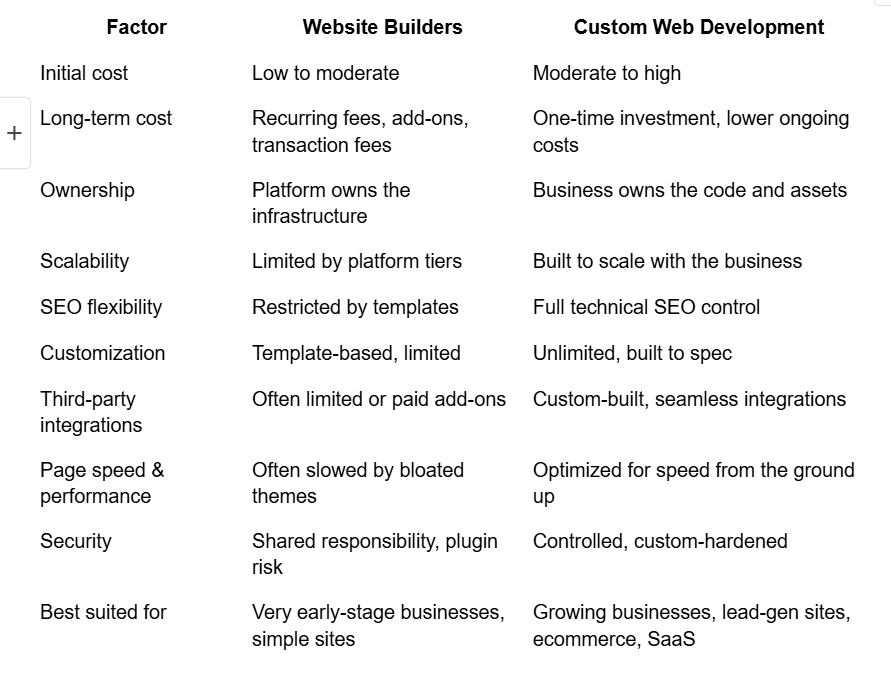
Not every business needs a custom build on day one, and that's a fair point. But certain situations make the ROI case for custom development much stronger:
You're scaling past a basic online presence.
If your website needs to support a growing product catalog, multiple service areas, or a sales funnel with multiple touchpoints, a builder's rigid structure becomes a bottleneck fast.
You're validating a new product or service.
Startups testing a new idea often benefit from a structured build process similar to MVP software development, where the website or web app is built lean first, then expanded based on real user feedback rather than guesswork.
You operate in a competitive local market.
Businesses competing for visibility in cities like Dallas, Austin, or Houston need every SEO and performance advantage they can get, which is part of why local service providers often turn to dedicated web development in Dallas rather than a generic template.
You need industry-specific functionality.
Sectors like logistics, healthcare, or finance often require custom dashboards, tracking systems, or compliance features. A logistics software development project, for example, might need real-time tracking and fleet management tools that no website builder offers out of the box.
Your website is a revenue driver, not just a brochure.
If your site directly generates leads, bookings, or sales, even small performance and conversion improvements translate into measurable revenue, which is where custom development earns back its cost fastest.
When evaluating website ROI, look beyond the build cost and consider the full picture over a 2-3 year horizon:
The biggest hesitation businesses have around custom development is risk: what if it goes over budget, takes too long, or doesn't get used to its full potential? This is largely a function of who builds it, not the approach itself.
Working with an experienced development team helps in a few practical ways. A team that offers flexible engagement models, including options to hire dedicated developers through staff augmentation, can scale resources up or down based on project phase rather than locking you into a fixed large team from day one. Similarly, if your custom website needs a companion mobile app, working with a team that can also hire Flutter app developers means your web and mobile experiences are built on a consistent foundation, rather than stitched together from separate vendors.
The goal of a good development partner isn't just to write code. It's to make sure the investment is structured in a way that pays off, with clear milestones, scalable architecture, and a roadmap that accounts for where your business is headed, not just where it is today.
Website builders aren't bad tools. They're just built for a specific stage of business, and most growing companies eventually outgrow them. The question isn't really "builder vs. custom" in isolation. It's whether your website needs to keep up with your business as it scales, integrates with other systems, and competes for visibility in your market.
If your website is meant to be a long-term business asset rather than a placeholder, custom web development typically delivers a stronger return, not because it's flashier, but because it's built to grow without hitting a wall. Before committing to either path, it's worth mapping out where your business expects to be in two years and asking honestly whether a template can get you there.
