


Boston is one of the most competitive technology markets in the United States. When searching for mobile app developers in Boston, you'll find a wide range of agencies offering everything from basic mobile applications to complex enterprise solutions. The city's thriving startup ecosystem, strong biotechnology sector, and access to university talent have created a dynamic market for app development services.
However, finding a company that can turn your idea into a reliable, scalable application takes more than comparing portfolios and prices. You need a development partner with the right technical expertise, a transparent process, and a proven ability to deliver results.
Whether you're a startup founder, business owner, or IT director exploring app development in Boston, this guide explains what to look for in a development partner, how much an app might cost, which warning signs to avoid, and what questions to ask before making your decision.
Boston has a large, highly specialized technology workforce. According to Built In Boston reposts, the metropolitan area had approximately 269,000 tech workers, representing about 9.4% of its overall workforce, based on a 2024 CompTIA survey.
This concentration of talent gives businesses access to experienced developers, designers, and technology consultants. At the same time, it creates a competitive market where freelancers, boutique agencies, established development firms, and offshore providers compete for similar projects.
With so many options available, choosing the right partner requires careful evaluation. A polished portfolio or an attractive proposal doesn't necessarily guarantee a successful outcome. The more important factors are a structured development process, clear communication, relevant industry experience, and a track record of delivering applications similar to yours.
Business expectations are also evolving. Today's users expect mobile applications to offer intuitive navigation, fast performance, personalized experiences, and reliable security. Depending on the product, artificial intelligence (AI) and machine learning can further improve functionality through intelligent search, personalized recommendations, predictive insights, and virtual assistants.
When evaluating Boston app developers, look for teams that understand how to implement these technologies where they provide genuine business value, rather than adding features simply to follow a trend.
Before comparing proposals, establish the qualities that distinguish a dependable development partner from an unreliable one. A professional mobile app development company in Boston should demonstrate the following capabilities.
A successful application starts with a well-defined process. Ask potential development partners to explain how they move from your initial idea to a finished product.
A structured process typically includes requirements analysis, project planning, UI/UX design, development, quality assurance, deployment, and ongoing maintenance.
The team should explain what happens at each stage, how progress is measured, and how your feedback will influence the final product. Agile development practices, regular sprint reviews, and clearly defined milestones can help you monitor progress and address issues before they become expensive problems.
Be cautious of companies that promise quick results without explaining how they will manage requirements, testing, and delivery.
Your development partner should recommend technologies that align with your application's requirements, target audience, budget, and long-term goals.
Depending on your needs, the team may recommend native development for iOS and Android or a cross-platform framework such as React Native or Flutter.
Native development can be appropriate when an application requires specialized hardware access, advanced platform-specific functionality, or demanding performance. Cross-platform development can help businesses share code across platforms, reduce duplicated development effort, and simplify maintenance.
An experienced Boston mobile app development team should explain these trade-offs clearly instead of pushing a particular technology simply because it is familiar to them.
Boston has a strong presence in healthcare, biotechnology, financial services, higher education, and logistics. If your application serves one of these industries, relevant experience can make a significant difference.
For example, healthcare applications may need to address HIPAA requirements, while payment-related applications may need to comply with applicable PCI DSS requirements. Educational platforms and financial applications can also involve sensitive information and industry-specific obligations.
Look for a development partner that understands the security, privacy, integration, and compliance considerations relevant to your project. The right experience can reduce implementation risks and help prevent costly redesigns later.
A reliable app development partner should provide a detailed estimate based on your requirements rather than an unexplained lump-sum price.
The proposal should identify the project's scope, major deliverables, development phases, estimated timeline, payment milestones, and assumptions. It should also explain which features or services may increase the overall cost.
Custom animations, third-party integrations, complex backend systems, administrative dashboards, advanced security requirements, and AI-powered functionality can all affect development time and budget.
Ask how additional requirements will be evaluated and approved. A transparent change-management process helps you control costs while keeping the project aligned with your business goals.
Launching an application is an important milestone, but it isn't the end of the development process.
Operating systems evolve, security vulnerabilities require attention, integrations change, and user feedback often reveals opportunities for improvement. Your development partner should offer a clear maintenance and support plan covering the services you need after launch.
Depending on the agreement, this may include bug fixes, performance monitoring, compatibility updates, security patches, technical support, and future feature development.
Before signing a contract, clarify the duration of any included support period, response times, maintenance fees, and the process for requesting updates.
Effective communication helps keep development projects on schedule and prevents misunderstandings.
Look for a team that provides regular progress updates, maintains a shared project management board, and assigns a dedicated project manager or primary point of contact. Weekly meetings or sprint reviews can help you understand what has been completed, what comes next, and whether any decisions are needed from your side.
If you're working with a distributed or offshore team, discuss time-zone overlap, meeting schedules, documentation practices, and expected response times before the project begins.
The best development partners treat communication as an essential part of project delivery, not an afterthought.
Not every development proposal delivers on its promises. Watch for these warning signs when evaluating potential partners.
Evaluating these warning signs early can help you avoid unnecessary expenses, missed deadlines, and preventable technical problems.
The cost of mobile app development in Boston depends on several factors, including application complexity, platform selection, design requirements, backend infrastructure, integrations, security needs, and ongoing maintenance.
The following estimates provide a general starting point for budgeting. Actual costs vary by development partner and project scope.
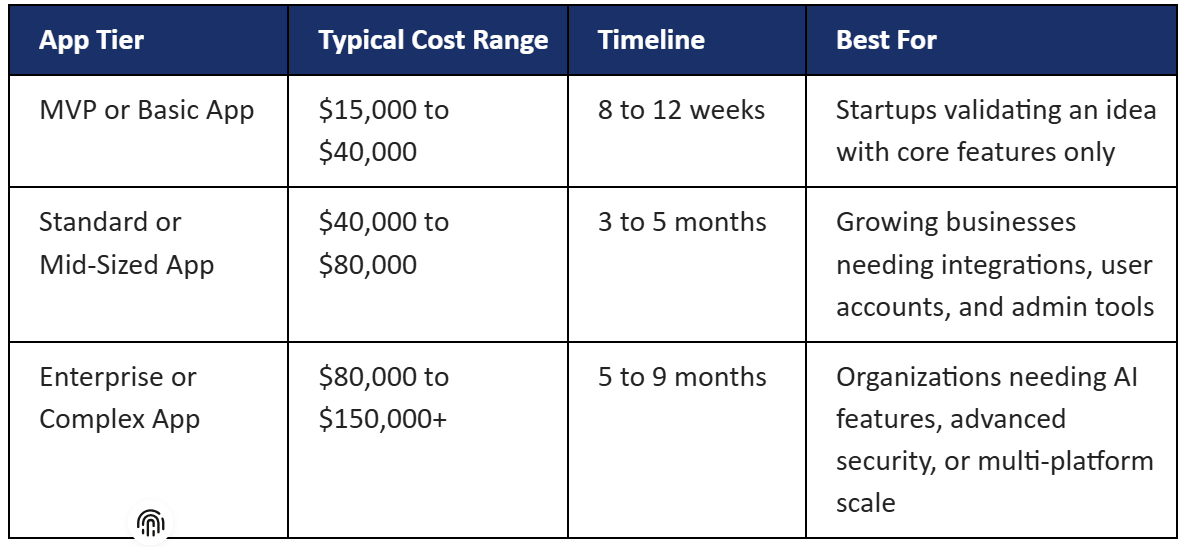
These figures are indicative planning estimates, not verified market averages or guaranteed quotes from Boston development companies.
Several factors determine the final project budget:
For a more accurate estimate, prepare a feature list and discuss your priorities with potential development partners. If your requirements are still evolving, consider starting with a minimum viable product (MVP) that focuses on essential features and allows you to validate your idea before investing in a larger release.
Choosing the right development model depends on your budget, project complexity, internal resources, and long-term plans.
An in-house team can be a good fit for businesses building a long-term digital product that requires continuous development and close collaboration with internal departments.
You gain direct oversight and can build product knowledge internally. However, recruiting developers, designers, testers, and project managers takes time and involves ongoing salary, benefits, equipment, and management costs.
A freelancer may be suitable for a small application, a prototype, or a project with a clearly defined scope and limited technical requirements.
This option can reduce initial costs, but one person may not have expertise in every area, including backend development, UI/UX design, quality assurance, and security. Availability and continuity can also become concerns if the project expands.
A development agency typically provides access to a broader team of specialists, including designers, developers, QA engineers, and project managers.
This model can offer a practical balance of expertise, flexibility, and delivery capacity without requiring you to recruit a full internal team. It is often worth considering for startups and small to mid-sized businesses that need multiple skills to bring an application to market.
Offshore and nearshore teams can offer access to a wider talent pool and potentially lower development costs.
However, evaluate communication practices, working-hour overlap, security procedures, contract terms, and experience with your target market. Lower hourly rates do not automatically translate into lower total project costs if coordination issues or rework increase the effort required.
For many small and mid-sized businesses, an agency can provide a useful combination of technical expertise and project management. An in-house team may be better for a product requiring continuous internal development, while a freelancer can work well for a smaller, straightforward assignment.
The right choice is the one that matches your project's complexity, available budget, internal capabilities, and long-term support needs.
Ready to Build Your App the Right Way?
Choosing the wrong development partner can cost you months of rework and a budget that balloons past your original estimate. Working with an experienced mobile app developer in Boston from the start protects your timeline, your budget, and your product's chances of actually reaching users.
GET YOUR FREE QUOTE
Mobile app development can range from approximately $15,000 for a basic MVP to $150,000 or more for a complex enterprise application. The final cost depends on features, platform requirements, integrations, design complexity, and the development team's rates. Request a detailed estimate based on your specific requirements.
A basic MVP may take around 8–12 weeks, while a standard application can require 3–5 months. Complex enterprise applications may take 5–9 months or longer. Actual timelines depend on project scope, integrations, testing requirements, and the speed of decision-making.
A local team may offer easier in-person collaboration, overlapping working hours, and familiarity with the regional business environment. Offshore teams can provide cost flexibility and access to a broader talent pool. Compare communication practices, relevant expertise, security, project management, and total cost before deciding.
Common industries include healthcare, biotechnology, financial services, education, logistics, and real estate. However, the right development company should be selected based on its experience with your application's requirements, not simply the industries it lists on its website.
Cross-platform frameworks such as React Native and Flutter can be suitable for many business applications because they allow developers to share code across iOS and Android. Native development may be preferable when an application requires specialized platform functionality, extensive hardware integration, or demanding performance. Your choice should reflect the product's technical requirements and long-term maintenance needs.
Finding the right mobile app developers in Boston involves more than comparing prices or choosing the company with the most impressive website. You need a development partner that understands your business objectives, has relevant technical expertise, communicates consistently, and can support your application beyond launch.
Evaluate each company's process, portfolio, pricing structure, testing practices, and contractual terms before making a decision. Ask direct questions, compare proposals on an equal basis, and prioritize long-term value over the lowest initial quote.
Boston offers access to a diverse pool of development talent. By taking a structured approach to your search, you can identify a partner whose capabilities and working style align with your goals and build a mobile application designed to deliver lasting value.
